

What is Financial Planning?
Embarking on a journey toward financial security and prosperity can seem daunting, but it becomes an attainable and rewarding endeavor with the right guidance. Financial planning is a comprehensive process that empowers you to take control of your finances, set achievable goals, and chart a course to realize your dreams. It’s a strategic approach that aligns your resources with your aspirations, ensuring that every dollar you earn and every investment you make propels you closer to your desired future.
Financial planning is about understanding your current financial landscape, identifying your short-term and long-term objectives, and developing a personalized plan to navigate the complexities of managing your money effectively. It’s a holistic exercise that considers every aspect of your financial life, from budgeting and debt management to investment strategies, tax planning, and estate preparation.
The Significance of Financial Planning
In today’s fast-paced and ever-changing world, financial planning has become an indispensable tool for individuals and families seeking to secure their financial well-being. By taking a proactive approach to managing your finances, you can:
Gain Clarity and Control
Financial planning provides a comprehensive overview of your financial situation, enabling you to understand where your money is going and how to allocate it more effectively. This newfound clarity empowers you to make informed decisions and take control of your financial destiny.
Achieve Your Financial Planning Goals
Whether you aspire to purchase a home, fund your children’s education, enjoy a comfortable retirement, or leave a lasting legacy, financial planning helps you identify and prioritize your goals and develop strategies to achieve them within your desired timeframe.
Prepare for Uncertainties
Life is unpredictable, and financial planning equips you with the tools to navigate unexpected events, such as job loss, medical emergencies, or economic downturns. By building an emergency fund, securing appropriate insurance coverage, and diversifying your investments, you can mitigate risks and safeguard your financial stability.
Maximize Your Resources
Financial planning enables you to optimize your resources by minimizing unnecessary expenses, reducing tax liabilities, and exploring investment opportunities that align with your risk tolerance and time horizon. This strategic approach helps you make the most of your hard-earned money.
Achieve Peace of Mind With Financial Planning
Perhaps the most significant benefit of financial planning is the peace of mind it provides. By proactively addressing your financial concerns and creating a roadmap for the future, you can alleviate stress and anxiety and focus on enjoying the present while working towards your long-term goals.
The Components of a Comprehensive Financial Plan
A well-crafted financial plan is a multifaceted document that addresses various aspects of your financial life. While the specific components may vary based on your unique circumstances, a comprehensive financial plan typically includes the following elements:
1. Cash Flow Management and Budgeting
Effective cash flow management is the foundation of any successful financial plan. It involves creating a budget that tracks your income, expenses, and savings, enabling you to identify areas where you can reduce unnecessary spending and allocate more resources toward your goals.
Budgeting Strategies For Financial Planning
- The 50/30/20 Rule: This popular budgeting method suggests allocating 50% of your income to essential expenses (housing, utilities, transportation), 30% to discretionary spending (entertainment, dining out, hobbies), and 20% to savings and debt repayment.
- Zero-Based Budgeting: With this approach, you allocate every dollar of your income towards specific expenses or savings goals, ensuring no funds are left unaccounted for.
- Envelope Budgeting: This old-school method involves dividing your income into different envelopes (physical or digital) for various expenses, helping you visualize and control your spending.
Regardless of your budgeting strategy, the key is finding a system that works for your lifestyle and helps you maintain a positive cash flow.
2. Debt Management
Carrying high-interest debt can be a significant financial burden, hindering your ability to save and invest for the future. A comprehensive financial plan should address your debts and provide strategies for reducing or eliminating them.
Debt Repayment Strategies
- Debt Snowball Method: This approach focuses on paying off your smallest debts first while making minimum payments on the larger ones. As each debt is eliminated, the funds are rolled over to the next largest debt, creating a “snowball” effect.
- Debt Avalanche Method: With this strategy, you prioritize paying off the debt with the highest interest rate first while making minimum payments on the remaining debts. This approach can save you money in the long run by minimizing interest charges.
- Debt Consolidation: If you have multiple debts with varying interest rates, consolidating them into a single loan with a lower interest rate can simplify your repayment process and potentially save you money.
By implementing an effective debt management strategy, you can free up more of your income for savings and investments, accelerating your progress toward your financial goals.
3. Emergency Fund
Unexpected expenses, such as medical bills, home repairs, or job loss, can derail even the most carefully crafted financial plan. Establishing an emergency fund is essential to safeguard against such eventualities.
Building an Emergency Fund
- Determine Your Target Amount: Most financial experts recommend having enough savings in your emergency fund to cover 3 to 6 months’ living expenses.
- Automate Your Savings: Set up automatic transfers from your checking account to a dedicated savings account, making it easier to contribute consistently to your emergency fund.
- Prioritize Your Emergency Fund: Before allocating funds towards other financial goals, ensure you have a solid emergency fund.
An emergency fund provides a financial safety net and peace of mind, allowing you to navigate unforeseen circumstances without compromising your long-term financial stability.
4. Retirement Planning As Part Of Your Financial Plan
Retirement planning is critical to any financial plan, ensuring you can maintain your desired lifestyle after leaving the workforce. This process involves establishing retirement goals, determining your retirement income needs, and implementing strategies to accumulate the necessary funds.
Retirement Planning Strategies
- Employer-Sponsored Retirement Plans: Take advantage of employer-sponsored retirement plans, such as 401(k)s or 403(b)s, which offer tax advantages and potential employer matching contributions.
- Individual Retirement Accounts (IRAs): If you don’t have access to an employer-sponsored plan or want to supplement your retirement savings, consider opening an IRA (Traditional or Roth) to take advantage of tax benefits.
- Diversify Your Investments: Allocate your retirement savings across various asset classes (stocks, bonds, real estate, etc.) to mitigate risk and maximize potential returns.
- Adjust Your Contributions: Periodically review your retirement contributions and adjust them as your income and expenses change, ensuring that you stay on track to meet your retirement goals.
By starting early and consistently contributing to your retirement accounts, you can leverage the power of compound interest and potentially accumulate a substantial nest egg for your golden years.
5. Investment Planning
Investment planning is integral to a comprehensive financial plan, as it helps you grow your wealth and achieve your long-term financial goals. This process involves determining your investment objectives, risk tolerance, and time horizon and developing an investment strategy that aligns with your unique circumstances.
Investment Planning Strategies
- Asset Allocation: To balance risk and potential returns, diversify your investments across different asset classes (stocks, bonds, real estate, etc.).
- Tax-Efficient Investing: To minimize tax liabilities and maximize investment growth, consider tax-advantaged accounts, such as 401(k)s and IRAs.
- Rebalancing: Periodically review and rebalance your investment portfolio to ensure it remains aligned with your target asset allocation and risk tolerance.
- Seek Professional Guidance: Consider working with a financial advisor or investment professional to develop and implement an investment strategy tailored to your goals and risk profile.
By implementing a well-crafted investment plan, you can potentially generate long-term wealth and achieve financial independence while mitigating the risks associated with market volatility.
6. Tax Planning
Effective tax planning is crucial for maximizing financial resources and minimizing tax liabilities. A comprehensive financial plan should include strategies to optimize your tax situation and ensure compliance with applicable tax laws and regulations.
Tax Planning Strategies
- Maximize Deductions and Credits: Identify and use all eligible deductions and credits to reduce your taxable income.
- Tax-Efficient Investment Strategies: Implement strategies such as tax-loss harvesting, asset location, and tax-deferred accounts to minimize your tax burden on investment gains.
- Charitable Giving: Explore tax-efficient ways to support causes you care about, such as donating appreciated assets or establishing a donor-advised fund.
- Retirement Account Strategies: Utilize tax-advantaged retirement accounts, such as Traditional IRAs and 401(k)s, to defer taxes on your contributions and investment growth.
By working with a qualified tax professional or financial advisor, you can develop a tax planning strategy that aligns with your financial goals and minimizes your tax liabilities.
7. Insurance Planning
Insurance planning is an essential component of a comprehensive financial plan, as it helps protect you and your loved ones from unexpected events that could have significant financial consequences.
Insurance Planning Strategies
- Life Insurance: Obtain adequate life insurance coverage to ensure that your loved ones are financially secure in the event of your untimely passing.
- Disability Insurance: Protect your income and ability to earn a living by securing disability insurance, which provides a financial safety net if you cannot work due to an illness or injury.
- Long-Term Care Insurance: Plan for potential long-term care expenses by exploring long-term care insurance options, which can help cover the costs of nursing home care, assisted living facilities, or in-home care.
- Homeowner’s and Renter’s Insurance: Safeguard your property and personal belongings by obtaining appropriate homeowner’s or renter’s insurance coverage.
- Umbrella Insurance: Protect your assets and future earnings from potential liability claims by considering an umbrella insurance policy, which provides additional liability coverage beyond your existing policies.
By carefully evaluating your insurance needs and obtaining appropriate coverage, you can mitigate the financial risks associated with unexpected events and ensure that you and your loved ones are adequately protected.
8. Estate Planning
Estate planning is organizing and managing your assets to ensure they are distributed according to your wishes after your passing. A comprehensive financial plan should include strategies for preserving and transferring your wealth to your beneficiaries in a tax-efficient manner.
Estate Planning Strategies
- Will and Trust Creation: Draft a will and consider establishing a trust to outline your wishes for distributing your assets and caring for any dependents.
- Beneficiary Designations: Review and update the beneficiary designations on your retirement accounts, life insurance policies, and other financial accounts to ensure that your assets are distributed according to your wishes.
- Asset Protection Strategies: Explore strategies such as trusts, gifting, and charitable giving to protect your assets from potential creditors or legal claims.
- Legacy Planning: Consider your philanthropic goals and develop a plan to leave a lasting impact on the causes or organizations that are important to you.
Working with an estate planning professional ensures that your assets are properly managed and distributed according to your wishes, minimizing potential conflicts and maximizing the inheritance for your beneficiaries.
9. Family Financial Planning
Family financial planning is a critical aspect of a comprehensive financial plan, as it helps ensure the financial well-being and security of your loved ones. This process involves identifying and addressing your family members’ unique financial needs and goals, including children, aging parents, or dependent relatives.
Family Financial Planning Strategies
- Education Funding: Explore strategies such as 529 plans, Coverdell Education Savings Accounts, or other investment vehicles to save for your children’s or grandchildren’s future education expenses.
- Dependent Care Planning: Evaluate the financial implications of caring for dependent family members, such as aging parents or children with special needs, and develop a plan to address their long-term care and support requirements.
- Wealth Transfer Strategies: Implement strategies to efficiently transfer your wealth to your beneficiaries, minimize potential tax liabilities, and ensure that your assets are distributed according to your wishes.
- Family Financial Education: Educate your family members on financial literacy and involve them in financial planning, empowering them to make informed decisions and develop healthy financial habits.
By incorporating family financial planning into your overall strategy, you can ensure that your loved ones are financially secure and prepared for the future while preserving and transferring your wealth responsibly and tax-efficiently.
10. Risk Management
Risk management is an integral part of a comprehensive financial plan. It helps identify, assess, and mitigate potential risks that could threaten financial security. By proactively addressing these risks, you can protect your assets and ensure the long-term viability of your financial plan.
Risk Management Strategies
- Diversification: To reduce the impact of market volatility and economic downturns, diversify your investment portfolio across various asset classes, sectors, and geographic regions.
- Insurance Coverage: Obtain appropriate insurance coverage, such as life, health, disability, and liability insurance, to protect yourself and your loved ones from financial losses due to unexpected events.
- Emergency Fund: Maintain an emergency fund to cover unexpected expenses and mitigate the impact of financial emergencies, such as job loss or medical emergencies.
- Stress Testing: Conduct regular stress tests on your financial plan to assess its resilience against potential risks, such as market downturns, inflation, or changes in tax laws.
- Ongoing Monitoring and Adjustments: Regularly review and adjust your financial plan to ensure that it remains aligned with your goals and risk tolerance and to address any new risks or opportunities that may arise.
By implementing effective risk management strategies, you can enhance the stability and longevity of your financial plan and ensure that you are well-prepared to navigate any challenges that may arise along your financial journey.
11. Monitoring and Adjusting Your Financial Plan
A financial plan is not a static document; it is a living, breathing strategy that should be regularly reviewed and adjusted to reflect changes in your personal circumstances, financial goals, and economic conditions.
Monitoring and Adjusting Your Financial Plan
- Periodic Reviews: Schedule regular reviews (e.g., annually or semi-annually) to assess the progress of your financial plan and make any necessary adjustments.
- Life Event Adjustments: Revisit and update your financial plan when significant life events occur, such as marriage, divorce, the birth of a child, a job change, or an inheritance.
- Economic Condition Adjustments: Monitor economic indicators and market conditions and adjust your investment strategies and risk management approaches accordingly.
- Goal Adjustments: Regularly reevaluate your financial goals to ensure they remain relevant and aligned with your evolving priorities and aspirations.
- Seek Professional Guidance: Work with a qualified financial advisor or planner to ensure your financial plan remains up-to-date and tailored to your unique circumstances.
Regularly monitoring and adjusting your financial plan ensures it remains relevant, effective, and aligned with your changing needs and goals. This will enable you to stay on track towards achieving your desired financial outcomes.
12. Embracing Financial Planning & Estate Planning with Legacy Keeper
Financial planning is a journey; like any journey, it requires a trusted companion to guide you along the way. Legacy Keeper is a powerful digital platform that empowers you to take control of your financial future, offering a comprehensive suite of tools and resources to streamline your financial planning process.
With Legacy Keeper, you can:
- Organize Your Financial Documents: Securely store and manage all your important financial documents, including bank statements, investment portfolios, insurance policies, and legal documents, in one centralized location.
- Collaborate with Professionals: Seamlessly share your financial information with trusted advisors, such as financial planners, accountants, or attorneys, enabling them to provide tailored guidance and support.
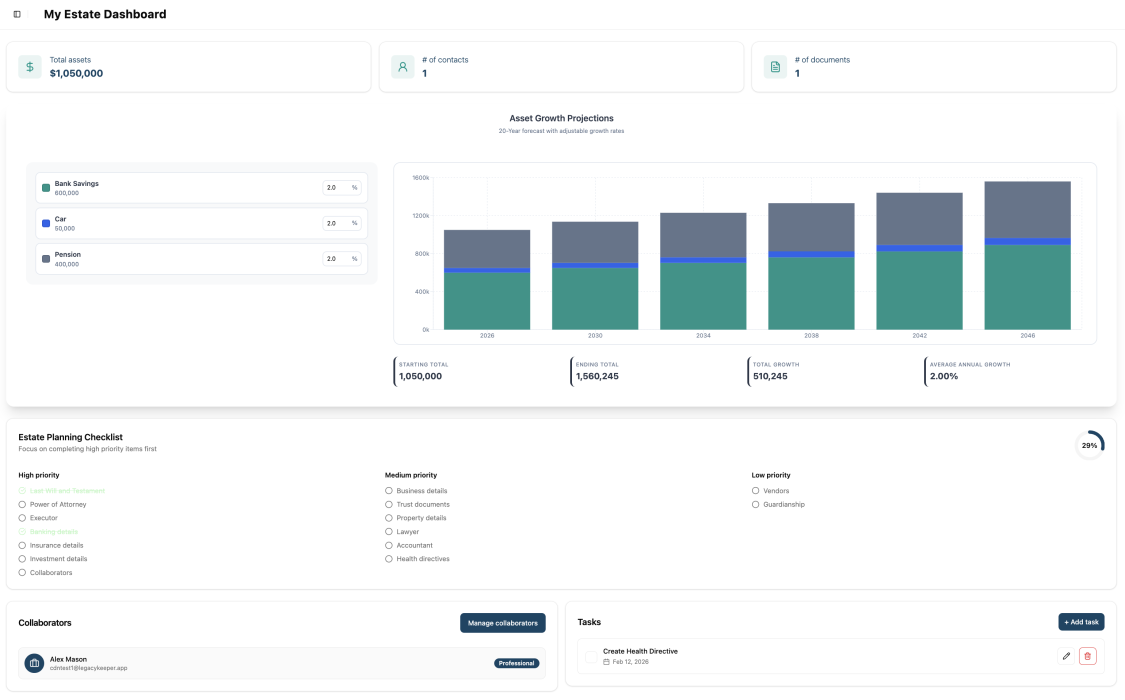
- Monitor Your Progress: Track your financial progress with checklists, tasks, reminders, net worth, and progress toward your goals. This will empower you to find and centralize the information that you need.
- Ensure Secure Access: LegacyKeeper’s robust security measures, including encryption and multi-factor authentication, protect your sensitive financial information from unauthorized access.
By leveraging LegacyKeeper’s power, you can streamline your financial planning journey, gain valuable insights, and make informed decisions that will propel you toward achieving your financial goals and securing a prosperous future for you and your loved ones.
Conclusion
Financial planning is a transformative process that empowers you to take control of your financial destiny. By developing a comprehensive plan encompassing all aspects of your financial life, you can confidently navigate the complexities of managing your money, mitigating risks, and achieving your short-term and long-term goals.
Whether you choose to embark on this journey independently or seek the guidance of a professional financial advisor, the key is to start today. Embrace financial planning as a lifelong commitment, regularly reviewing and adjusting your plan to reflect your evolving circumstances and aspirations.
With the right mindset, Strategies, and the support of powerful tools like LegacyKeeper, you can unlock the path to financial wellness and create a legacy that transcends generations. Embrace the journey, stay committed, and watch your financial dreams become a reality, one step at a time.

Leave a Reply