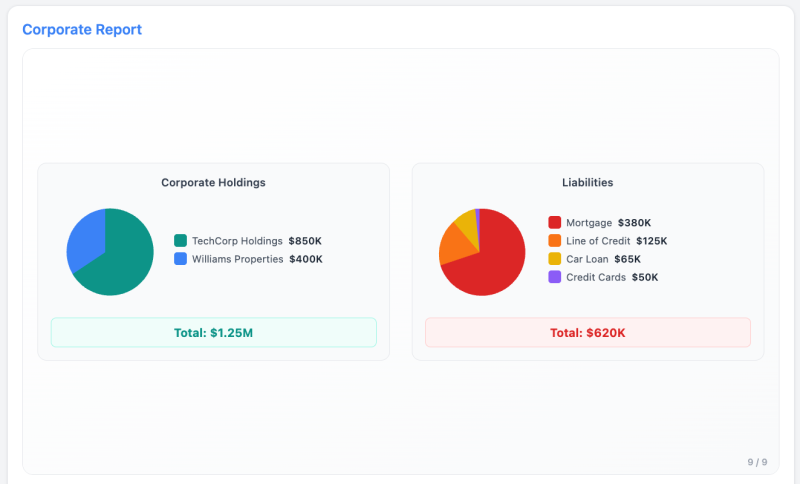
LegacyKeeper’s Corporate Report feature transforms how financial advisors approach corporate estate planning. This AI-first solution offers insights and charts that display corporate holdings and liabilities side by side. Advanced asset categorization, real-time liability tracking, and AI recommendations help advisors quickly identify succession planning, tax optimization, and wealth transfer opportunities. This ensures clients’ corporate assets remain protected and maximized through effective corporate estate planning.
Corporate Report Feature Overview
LegacyKeeper’s Corporate Report feature leads AI-first corporate estate planning technology. Built for financial advisors serving business owners, this tool provides a clear, interactive view of corporate holdings and liabilities. The AI streamlines corporate estate planning data analysis and improves advisor-client communication. Advisors become strategic partners in maximizing business value. The simple dual-dashboard shows all corporate holdings by entity and breaks down liabilities such as mortgages, lines of credit, and loans. Advisors gain a complete, actionable view to optimize clients’ business estates as part of a modern corporate estate planning process.
This feature integrates seamlessly with LegacyKeeper’s AI agent infrastructure. It does more than display static data. The system actively analyzes ownership structures, shareholder agreements, and liability obligations. It aligns these with estate planning goals. Instant summaries at the bottom of each dashboard show gross corporate value and total debt exposure. Advisors use these insights to calculate net business equity and drive strategic discussions about succession, tax efficiency, and wealth transfer.
The Problem This Feature Solves
Financial advisors face real challenges when analyzing business interests in estate plans. Traditional methods require manual compilation of corporate records, shareholder agreements, and financial statements from different sources. Advisors often track business valuations and debts in separate spreadsheets. This makes it hard to see the full picture of net corporate value and its effect on the estate.
Additionally, many business owners don’t fully understand how their corporate holdings affect estate planning. They may have significant equity tied up in private companies without clear succession plans, or substantial liabilities that reduce the actual value transferable to beneficiaries. Without a systematic way to visualize corporate assets alongside their obligations, advisors struggle to communicate the true financial picture and recommend appropriate restructuring strategies that could protect business value for future generations.
How the Feature Solves These Challenges
LegacyKeeper’s agent-first architecture automates the most complex aspects of corporate estate planning analysis. The feature solves advisor challenges through three key capabilities:
Visual Holdings Dashboard: The Corporate Report automatically organizes business interests by entity and displays their values in an easy-to-understand pie chart format. Advisors can instantly see the relative size of each corporate holding, understand the composition of total business equity, and identify which entities represent the largest concentration of value requiring succession planning attention.
Comprehensive Liability Tracking: The accompanying liabilities chart categorizes all business-related debts, including mortgages, credit facilities, loans, and credit obligations. This side-by-side presentation enables advisors to calculate net corporate value immediately and identify specific liabilities that may need to be addressed before ownership transfers or business succession events.
AI-Generated Recommendations: Based on the complete corporate picture, the system produces prioritized discussion points and recommendations covering business succession strategies, tax optimization through corporate structures, liability management, and coordination between corporate holdings and the broader estate plan. These insights help advisors guide productive conversations about protecting and transferring business value.
How to Use the Corporate Report Feature
Getting started with the Corporate Report feature involves these straightforward steps:
- Input Corporate Holdings: Enter your client’s business interests, including holding companies, operating businesses, real estate corporations, and partnership interests. Include ownership percentages, current valuations, and shareholder details for each entity.
- Scan Corporate Documents: Upload relevant documents, including shareholder agreements, corporate articles, buy-sell agreements, and recent financial statements. LegacyKeeper’s AI automatically extracts ownership details, valuation information, and governance provisions.
- Record Business Liabilities: Enter details about mortgages, lines of credit, business loans, and other obligations associated with corporate holdings. Include current balances, interest rates, and maturity dates for each liability.
- Review and Reconcile: Compare AI-extracted information against manually entered data. LegacyKeeper’s reconciliation process flags discrepancies between corporate documents and client-provided details, ensuring accuracy before generating analysis.
- Review the Corporate Report: Examine the visual dashboard to understand how corporate holdings are structured and where liabilities concentrate. Note the total holdings value, total liabilities, and calculate net corporate equity.
- Generate AI Analysis: Click generate to produce AI-powered discussion points covering succession planning opportunities, tax optimization strategies, and recommendations for coordinating corporate holdings with the overall estate plan.
- Prepare Client Deliverables: Use the discussion points and recommendations to create comprehensive client reports that clearly communicate current corporate structure, net business value, and recommended optimization strategies.
Summary
LegacyKeeper’s Corporate Report feature is a breakthrough for business owner corporate estate planning. Advanced AI, visual asset categorization, and liability tracking help advisors find succession planning and tax optimization opportunities fast. Clients gain protected business value, better succession plans, and efficient wealth transfer. Advisors deliver deeper insights as part of a truly holistic corporate estate planning service.
Frequently Asked Questions
Q: What types of business interests can I track in the system?
A: The system supports comprehensive tracking of corporate holdings, including private holding companies, operating businesses, real estate corporations, limited partnerships, and professional corporations. Each entity can be tracked with ownership percentages, current valuations, and shareholder details.
Q: How does the system calculate net corporate value?
A: LegacyKeeper calculates net corporate value by subtracting total liabilities from total corporate holdings. The visual dashboard prominently displays both figures, allowing advisors and clients to immediately understand the true equity value available for estate planning purposes.
Q: Can the AI identify succession planning opportunities?
A: Yes. The AI analysis evaluates corporate structures, ownership arrangements, and estate planning goals to identify specific succession planning opportunities such as estate freezes, share reorganizations, and buy-sell agreement recommendations that can protect business value during ownership transitions.
Q: What liability categories does the report track?
A: The Liabilities section tracks mortgages, lines of credit, business loans, car loans, credit card obligations, and other debts associated with corporate holdings. Each liability is displayed with its current balance and contributes to the total liabilities calculation.
Q: How do the AI-generated discussion points help with client conversations?
A: The discussion points provide specific, context-aware talking points for client meetings. Rather than presenting raw numbers, advisors receive insights explaining how corporate structures affect estate planning, what tax optimization opportunities exist, and what strategies can protect business value for beneficiaries. This enables more productive conversations about business succession and wealth transfer.

Leave a Reply