Legacy Keeper’s new AI Estate Planning Tax Agent transforms Estate Planning Tax for financial advisors and clients. This AI-powered agent breaks down assets by ownership type: Personal Assets, Trust Holdings, Joint Property, and Corporate Assets. It calculates the estimated capital gains tax for each category. The agent uses visual asset categorization and advanced AI tax analysis to generate concise discussion points. Advisors quickly identify tax optimization opportunities and deliver clear, actionable guidance that reduces tax exposure and increases wealth transfer.
What Is the Tax Report Feature?
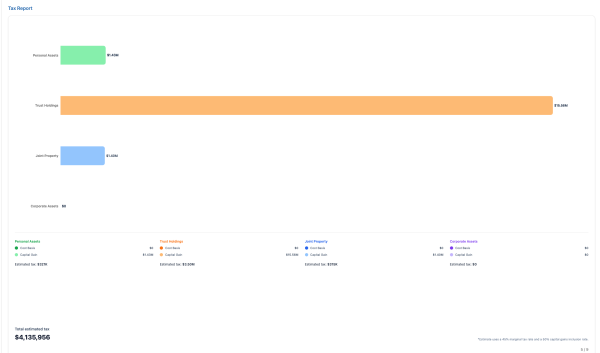
The AI Estate Planning Tax Agent helps financial advisors deliver estate planning services faster. The agent shows an easy-to-read bar chart that organizes client holdings into four categories: Personal Assets (individually owned), Trust Holdings (in trust structures), Joint Property (co-owned), and Corporate Assets (business interests and holdings).
This agent stands out because it uses Legacy Keeper’s advanced AI infrastructure. The AI Estate Planning Tax Agent does more than show asset information. Each category displays total value, cost basis, and capital gain. A summary shows the total estimated tax for the entire estate. The agent automatically identifies tax exposure based on ownership and beneficiary structures.
The Problem This Feature Solves
Financial advisors face significant challenges when analyzing clients’ estate structures to identify tax optimization opportunities. Traditional approaches require manual compilation of asset lists from multiple sources, spreadsheet-based calculations of capital gains, and time-consuming research into tax implications for different ownership structures. This fragmented process makes it difficult to provide clients with a clear picture of their potential tax liability at death.
Additionally, many clients have substantial tax exposure without realizing it. Individually owned assets trigger a deemed disposition at death, potentially resulting in significant capital gains tax that must be paid before beneficiaries receive their inheritance. Without a systematic way to visualize asset ownership, centralize cost basis, and analyze tax exposure, advisors struggle to communicate these risks effectively and recommend appropriate restructuring strategies that could save clients hundreds of thousands of dollars in unnecessary taxes.
How the Feature Solves These Challenges
Legacy Keeper’s agent-first architecture automates complex Estate Planning Tax work. The AI Estate Planning Tax Agent solves advisor challenges with three main capabilities:
Visual Tax Categorization: The Tax Report automatically organizes assets by ownership type and displays total values per category, along with cost basis and capital gain breakdowns. Advisors can instantly see the tax exposure for each ownership structure, enabling focused conversations about restructuring opportunities to reduce the overall tax burden.
Intelligent Tax Analysis Engine: The AI analyzes the complete asset picture and generates specific discussion points covering potential tax liability, missing information that prevents comprehensive planning, and tax optimization opportunities. Each discussion point includes calculated figures based on jurisdiction-specific tax rates and provides actionable recommendations.
Actionable Recommendations: Based on the analysis, the system produces prioritized recommendations aligned with the client’s estate planning goals and values. These recommendations include specific actions such as obtaining property appraisals to establish an accurate cost basis, evaluating principal residence designations for maximum tax savings, and exploring tax-efficient ownership structures, such as trusts or holding companies.
How to Use the Estate Planning Tax Agent Feature
Getting started with the Tax Report feature involves these straightforward steps:
- Input Asset Information: Enter your client’s assets, including real estate, bank accounts, investments, retirement accounts, and business interests. Include ownership type, current fair market values, and original purchase prices (cost basis) for each asset.
- Scan Key Estate Planning Documents: Upload your client’s essential estate documents, including wills, trust agreements, and property deeds. Legacy Keeper’s AI automatically extracts critical data, including asset descriptions, ownership details, and acquisition information.
- Review and Reconcile: Compare the AI-extracted information against manually entered data and client-provided details. Legacy Keeper’s comprehensive reconciliation process flags any discrepancies, ensuring all estate details align with current values before generating the tax analysis.
- Review the Tax Report: Examine the visual categorization to understand how assets are currently structured and where tax liability concentrates. Note the cost basis, asset values and exposure per category.
- Generate AI Analysis: Click generate to produce AI-powered discussion points, tax optimization recommendations, and a list of documents or information needed for comprehensive planning.
- Address Information Gaps: Review the system’s list of missing information, such as purchase prices, acquisition dates, and principal residence history. Gather this data to enable complete tax calculations.
- Prepare Client Deliverables: Use the discussion points and recommendations to create comprehensive client reports that clearly communicate current tax exposure, identified risks, and recommended optimization strategies.
Summary
The AI Estate Planning Tax Agent is a breakthrough for financial advisors and clients. It combines visual asset categorization, automated capital gains calculations, and advanced AI recommendations. Legacy Keeper helps advisors find tax optimization opportunities and create effective estate planning tax approaches in minutes, not hours. Clients benefit from reduced tax exposure, strategic restructuring, and efficient wealth transfer. Advisors deliver deeper value while working more productively.
Estate Planning Tax Agent FAQ
Q: How does the system identify tax exposure?
A: Legacy Keeper estimates tax exposure based on the difference between the current fair market value and cost basis (original purchase price) for each asset. The system evaluates asset costs, values, and ownership structures to identify which assets and entities have the greatest exposure by jurisdiction.
Q: What information do I need to get accurate tax calculations?
A: For accurate calculations, you need original purchase prices (cost basis), acquisition dates, current fair market values, and principal residence designation history for real estate. The AI analysis will identify specific gaps in client data and help you gather the precise information needed for complete recommendations.
Q: Can the Tax Report identify missing information?
A: Yes. The AI analysis identifies specific gaps in client data that prevent comprehensive planning, such as missing purchase prices for capital gains calculations, unknown acquisition dates, and unclear principal residence history. This helps advisors gather the precise information needed for complete tax optimization recommendations.
Q: What do the different asset categories mean?
A: Personal Assets are individually owned property that potentially trigger taxes on death depending on the jurisdiction. Trust Holdings are assets protected within trust structures that may be subject to different tax treatment. Joint Property includes co-owned assets that may pass to surviving owners. Corporate Assets encompass business interests and holdings that have their own tax implications. Each category has different tax consequences that the report helps visualize.
Q: How do the AI-generated discussion points help with client conversations?
A: The discussion points provide specific, data-driven talking points for client meetings. Rather than presenting raw numbers, advisors receive context-rich analysis that explains potential tax liability, the financial impact, and strategies to address each concern. This enables more productive and focused planning conversations that help clients understand why certain structures create tax exposure and what options exist to minimize it.

Leave a Reply