
LegacyKeeper’s Health Directive and Personal Care Planning feature helps financial advisors track health directive documents, like Medical Directives (Living Wills) and Powers of Attorney. It quickly identifies healthcare coverage gaps, which are often missed in estate planning. The AI-powered dashboard shows which key documents and insurance policies are present or missing. Automated tracking, gap analysis, and AI-generated talking points guide advisors and help them close gaps before they become problems.
What Is the Health Directive & Personal Care Planning Feature?
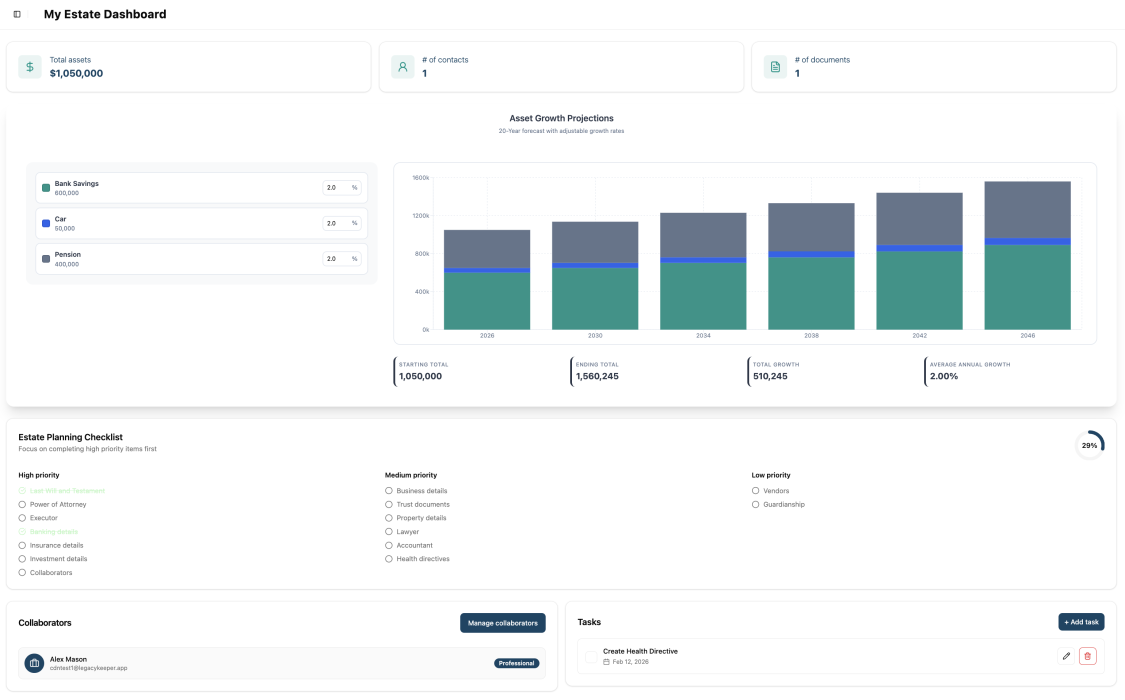
The Health Directive & Personal Care Planning feature gives advisors a single tool for managing health directive documents and verifying healthcare coverage. The dashboard uses a circular progress indicator to show the percentage of completed documents and policies. A checklist highlights what is in place and what is missing.
This feature uses LegacyKeeper’s AI to track documents, analyze planning status, and generate tailored talking points. The dashboard covers six categories with a focus on health directives: Power of Attorney, Medical Directive (Living Will), Health Insurance, Disability Insurance, Long-Term Care Insurance, and Critical Illness coverage. Green checkmarks show completed items; red indicators show gaps. The system encrypts all client data and complies with privacy laws, so advisors can trust it with sensitive information.
The Problem This Feature Solves
Financial advisors face challenges when helping clients with medical care planning. Estate planning and medical directives are usually separate. This separation creates gaps that become obvious in emergencies. Some clients have a general Power of Attorney that does not cover healthcare. Others lack documentation for medical treatment preferences. In a crisis, families must make difficult decisions without guidance.
Medical care planning discussions are emotionally challenging. Clients may avoid topics like end-of-life preferences, insurance gaps, or serious illness planning. This avoidance, combined with a lack of structure, makes it hard for advisors to protect clients fully. Estate plans may remain incomplete when support is most critical. The feature bridges the gap between problems and solutions. It offers three capabilities that create a clear, actionable framework for advisors and clients:
Visual Gap Analysis: The Health Report dashboard gives advisors a quick visual summary of client documentation. The circular progress indicator shows overall completion, and the checklist identifies specific gaps. Advisors can see whether a client has a Power of Attorney but is missing a Medical Directive, enabling targeted conversations about what is needed.
Intelligent Discussion Points: The AI reviews the client’s full medical planning profile and generates context-specific discussion points. Instead of generic checklists, advisors receive tailored prompts that address the client’s unique needs, such as clarifying if a Power of Attorney covers healthcare decisions or preparing decision-makers for their roles.
Actionable Recommendations: Based on the gap analysis, the system provides prioritized recommendations aligned with medical planning best practices. These include creating Living Wills, verifying the scope of Power of Attorney, setting up document distribution, and identifying backup healthcare decision-makers.
How to Use the Health Directives & Personal Care Planning Feature
To get started with the Health Directives & Personal Care Planning feature, follow these steps:
- Input Health Information: Work with your client to enter current health status details, including existing medical conditions, medications, healthcare providers, and relevant family medical history.
- Record Insurance Coverage: Enter details for health, disability, long-term care, and critical illness insurance policies, including policy numbers, coverage amounts, and beneficiary information. By ensuring that all relevant insurance information is recorded, advisors can proactively avoid unintended coverage lapses or unexpected premium changes. For example, an advisor who enters a client’s long-term care policy details and renewal dates can set timely reminders for premium payments, thereby preventing unintentional policy cancellation and loss of coverage. This step elevates the process from simple data entry to a revenue-protecting service, enhancing client satisfaction and encouraging long-term financial stability.
- Review the Health Report: Use the dashboard to assess the client’s current medical planning status by examining the completion percentage, then systematically review each checklist item to pinpoint any missing documents or incomplete areas that require follow-up.
- Generate AI Analysis: Click generate to produce AI-powered discussion points, recommendations, and a prioritized list of documents or data required for thorough healthcare planning.
- Prompt the Agent: Further personalize the output for your client’s needs.
- Print The Slide: Download any associated visuals in PowerPoint format so that you can continue editing to ensure your brand and voice are maintained in your client communication.
- Facilitate Client Conversations: Use talking points to guide sensitive medical planning conversations. Document client preferences for treatments, end-of-life care, and healthcare decision-makers. Clients access and update information through a secure portal. This process empowers clients and improves collaboration. Encourage clients to review and approve the AI-generated summary. This reinforces their ownership and responsibility. Save reports to client dashboards for easy access.
Health Directive Summary
The Health Directives & Personal Care Planning feature changes how financial advisors address healthcare in estate planning. With visual progress tracking, automated gap analysis, and AI-generated discussion points, advisors can manage medical planning topics with increased structure and confidence. Advisors can tailor discussion points to meet specific client needs or legal requirements, which enhances the tool’s practical value. However, certain limitations may arise when using this feature. For example, the tool’s effectiveness depends on the completeness and accuracy of client data input, and some documents or insurance policies may contain complex language that could challenge both users and the AI’s capacity to interpret legal nuances. Additionally, clients who are reluctant to engage in sensitive discussions may still resist comprehensive planning, even with structured prompts. These challenges highlight the importance of ongoing advisor oversight and communication to ensure the platform is used thoroughly and effectively. Despite these limitations, the tool’s versatility can support better client outcomes and contribute to more complete estate planning services.
Health Directive Agent FAQ
Q: What documents does the Health Report track?
A: The system tracks six essential categories: Power of Attorney (for healthcare decisions), Medical Directive or Living Will, Health Insurance, Disability Insurance, Long-Term Care Insurance, and Critical Illness coverage. Each category displays a clear status indicator to help you identify gaps immediately.
Q: How does the system know if a Power of Attorney covers healthcare decisions?
A: When you upload a Power of Attorney document, the AI reviews its scope and authority. The system will indicate whether healthcare decision-making is covered or if a separate Power of Attorney for Personal Care is required.
Q: Can the AI help prepare healthcare decision-makers for their role?
A: Even though drafts are not generated, the talking points provide guidance for preparing designated healthcare decision-makers, ensuring they understand the client’s values and preferences, and identifying backup appointees if needed.
Q: What if my client has some documents but not others?
A: The dashboard accommodates partial completion. The circular progress indicator shows overall completion, and individual items display green checkmarks or red indicators. This allows you to recognize progress and focus on remaining gaps.
Q: How do the AI-generated discussion points help with difficult conversations?
A: These discussion points offer structured, context-aware prompts that make sensitive topics easier to address. Instead of open-ended questions about end-of-life care, advisors receive specific prompts on healthcare values, treatment preferences, and decision-maker preparation, enabling more productive and focused planning conversations.

Leave a Reply